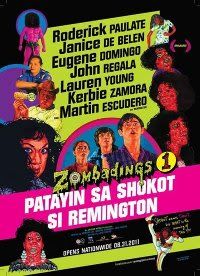
 Have you seen Zombadings 1: Patayin sa Shokot si Remington yet? If not, why not? It’s like one of the funniest local films this year and quality films like these need our support.
Anyway, I managed to have an interview with the movie’s director Jade Castro, who also helped create the script for the movie. Read on below for the interview. 
Vince: First of all, I would like to congratulate you on the
successful launch and screening of Zombadings. I’ve seen it twice and
I must say that it has been very entertaining. So, how do you feel,
now that Zombadings is receiving rave reviews and accolades (including
a rare 5-star rating from a popular online movie critic)?
Jade: I felt... relieved. Haha. We certainly made a film that wasn’t
safe, so we were never really sure how it was going to be received. We
HOPED people would like it, but there was no guarantee. So I really,
really feel a weight off everytime good feedback comes pouring. Also,
we knew how important the good word-of-mouth was, because we didn’t
have money for TV ads to promote the film. We NEEDED people to like
it, or else we wouldn’t survive in theaters. So I’m also very thankful
for the praises. People can be so generous! I remember running into
Phil Dy after the very first screening, at the CCP, and he told me he
thought it was the most subversive film ever! And I didn’t know if
that was a good thing exactly. The five stars puts it in an easy to
understand context. Haha.
V: Zombadings, which is just the third film you have directed, is now
your second film to receive an “A” rating from the Cinema Evaluation
Board after Endo. Do you think that puts pressure on you to live up to
people’s high expectations in future projects?
J: No, because I’m not famous. I doubt many people will even remember
the name of the director. This gives me freedom to do whatever I want
next. But I do put some pressure on myself, not in order to live up to
some pattern, like a chain—I personally dislike an auteur theory that
states a filmmaker must be consistent—but because I just want
everything I do to be kind of worthwhile.
V: Not famous? I guess we need to remedy that. Being indie, the
film had minimal marketing compared to mainstream movies, but it still
generated a lot of word-of-mouth buzz. Did you expect that Zombadings
would become a success in this regard?
J: We wanted it to be a success, we wanted it to be seen by as many
Filipinos as possible, and we wanted to make money out of it, and we
wanted to please our investors and partners too, because we want to
keep on making films. We found ways to market the film, even without
big network TV backing. The marketing we’ve done was minimal only in
terms of budget, but not in effort. We had to work hard and be
creative, especially because a Star Cinema movie (that was also a
comedy) also opened on the same playdate. If you ask me, I think our
marketing was grand and out-of-the-box and surprising, compared to
them. What they had that we didn’t were TV spots and the guns to put
their movie in as many theaters as possible because of their
relationship with theater owners. The word-of-mouth was crucial to our
plan. It’s something the studios never do, because they always finish
their films in the nick of time. They bombard us instead with
commercials. We, on the other hand, had time in our favor. We invested
in advance screenings so that people will have time to spread the word
around.
V: I actually think that your marketing efforts did pay off. I
personally know of people who had wanted to see the film because of
the word-of-mouth. And investing in social media, like Twitter and
Facebook, is both economical and effective as well. So kudos on
showing that a movie can become the talk of the town without needing
to advertise on television.
J: It wouldn’t have worked if people didn’t actually like/love it.
Thank you to the people.
V: What do you think will be the influence of Zombadings on the local
indie film industry, especially the gay segment, which has, sorry to
say, been producing a lot of really badly done films these past few
years?
J: I don’t know. Only time will tell. I know what you mean about the
gay indies. I watch a lot of them. I wouldn’t want to generalize
because there are a few every now and then that are worthwhile, and
there’s a market for gay stories that the big studios would never
touch. My complaint with bad filmmaking is not limited to gay indies.
Major studios make bad films, too. And there are bad arthouse/festival
films, also. But there are good stuff, too. I doubt Zombadings will be
seen as a primer on good filmmaking -- haha, that would be funny --
but I can see how its success could maybe stretch the possibilities a
bit of what cinema could be in this country, or what audiences are
willing to try. Industry people can be overly literal when analyzing
phenomena, so I wouldn’t be surprised if they pick apart the elements
of the film and maybe attribute the success to, say, the gay element,
or certain jokes, or, you know, details. I hope the legacy it leaves,
if ever, is larger. My friend, director Mario Cornejo, summed it up
best, I think, when he tweeted: “Concepts are important and all, but
commitment is the key. #Zombadings proves that you can even make a
gayzombieserialkiller movie work.”
V: I agree that major studios can produce bad films too, but I would
have to say that gay indies seem to be the champs in setting the bar
lower and lower. Some gay indie movie producers seem to think that
just putting bare skin on screen is the sole key to success, but I’m
increasingly resenting paying 150 pesos or more for a film that
doesn’t seem worth its weight in film reels. If I wanted skin, I find
more satisfaction browsing through free videos in online adult sites.
I really want to support the gay indie film industry but the industry
is making it hard for us to do so. While Zombadings might not be seen
as a paragon of gay indie filmmaking, I hope that it proves that one
can invest in a film with enough of the fundamentals and technicals
down right to be an unexpected success.
J: You’re right, it’s frustrating when a film has skin to offer but
not much else. I feel the same way with studio films that offer only
stars, or a formula, or whatever ingredient they think is enough to
make a film worth our money, but is not. I disagree with you. There
are studio films that are worse than the worst of the gay indies. You
shouldn’t feel obligated to watch movies you don’t want to. It’s the
job of moviemakers to make their movies interesting for you. If
they’re advertising skin and that’s not what you want, then by all
means stay away. However, it’s also sadly the audience’s loss when
they decide to shut out an entire genre because of a few bad apples.
I’m an audience member first, and it’s true that expectations can’t be
helped, but I also like the idea of walking into a movie and somehow
end up being surprised. With Zombadings, I think there was a hurdle
for us, with people who were predisposed to avoiding gay-themed films,
or even independent films, or even films with silly titles, or films
that don’t fall under the usual standards of good taste. Which is why
I get giddy when people say they were surprised by how much they liked
the film.
V: As you said, many people liked the film. But of course not everyone
did. There was this one particularly scathing review posted by Michael
David C. Tan online at Outrage Magazine. What can you say regarding
the points raised by Mr. Tan in his review?
J: To be honest, we expected an anti-gay reading very early on, when
the film wasn’t even finished. Even during the writing, we were aware
it could ruffle some feathers, beginning with the very provocative
premise of a gay curse. How politically incorrect! So we’ve been
sensitive from the start, but also brave and not dodge prickly issues.
But I think the first time we ever heard someone actually say “It’s
anti-gay” was from an executive at Star Cinema, who saw an early,
unfinished cut of the film, back when we showed it to them for
possible distribution. They didn’t like it, of course. When that
article by Michael David Tan came out—I think immediately, a day or
two after the very first public screening—I was perplexed by its
content. I worried for a while, because the values he was advocating
in that article were also our advocacies, so it really did seem like
we were being offensive, and yet we knew very well we had nothing but
love and respect, we did our homework, we had been working on the film
inside and out for close to two years! But I was concerned, too,
because I felt that if a party took a real offense, it should not be
taken lightly. His claim that the movie will lead to gay killings was
scary. I would never forgive myself if people actually died because of
the film. So I took that article seriously, and with the help of
friends, studied each part carefully. In the end, I can say that Mr.
Tan had simply misread the film. Thankfully, his opinion remains in
the minority. People, including many LGBTQs, find the film to be a
positive, enriching experience. There have even been articles written
by other people who counter his argument.
V: To be fair to Mr. Tan, I think that a few of his points may have
some merit. While a comedy film should not be taken too seriously,
there’s a worry that people who have preconceptions that gay men like
to cross-dress or act feminine would have their notions reinforced
upon seeing Zombadings, or that some people might leave the theater
continuing to believe that gay people enjoy wearing baby-tees,
shashaying their hip, and saying “keribels,” ignorant of the fact that
LGBT men and women come in all types. Do you think this is valid or is
this just worrying too much?
J: Remington was turning into a particular queer image, and this is
the image that he loathes, the one he makes fun of as a homophobe, and
also this is the image that reflects that of the person who cursed
him, the role played by Roderick Paulate. It’s a very particular
transformation and is never meant to encompass the entirety of the gay
experience, because that would be impossible. It’s too diverse. I
think it says a lot about the gay men in the audience who react
negatively to this image. What’s wrong with transgenders? Or
effeminate gay men who like to speak in baklese and wear tight
clothes? I find it sadly ironic that some people refuse to identify
with Remington or the film just because of this. What I’ve been
hearing so far are a few gay men who are concerned about what people
will think about them after seeing the movie. I haven’t actually heard
anyone say their preconceived false notions were reinforced or some
such effect. It’s all so far a lot of second guessing and a fear of
not being accepted. This is ironic because transgenders are more
marginalized than discreet gay men, as attested by the lack of
employment opportunities for them, to name one example. Obviously
there’s non-acceptance even within the LGBTQ community. Having said
that, we did sprinkle the film with other representations. I wonder
how people would label Remington’s best friend Jigs (Kerbie Zamora),
or one of his basketball buddies, the muscular Odie (Herson Barias),
or the once-married middle aged Mang Berting (Ward Luarca), and
others, not to mention the women. Also, this is a small, close-knit,
rural town. Obviously it isn’t a melting pot, and we’re limited in
ways that are integral to the location, and a specific local mindset
and behavior. I think many in the audience get it, and get that
there’s a real issue to be tackled in the real world, and the film in
fact pushes for that discussion.
V: These are indeed very good points. I guess if there are people who
misinterpret or fail to see past the queer personas in the film then
the problem is with them, not with the film. Going to another topic,
why did you guys decide to shoot in Lucban, Quezon?
J: The film was based on a true incident that happened there. Raymond
Lee (writer, producer) was walking in the streets of Lucban when a
little boy called out to him, “Bakla!” That same afternoon, Raymond
pitched the concept to me. So we were inspired by Lucban from the very
start. Raymond, Michiko Yamamoto, and I later cooped up in a house in
Lucban to write the initial draft of the script. We decided there was
no other place to shoot this but Lucban. It was also visually perfect.
It’s a beautiful town. And the houses are bunched together and the
streets are small, you’d believe it’d be a real calamitous situation
if zombies attack. Also, I love the cool weather! Great for shooting.
V: How did the townspeople receive your making the film in Lucban, and
one that has gay zombies to boot?
J: They had no problem with it. In fact, most of the Zombadings were
played by locals. Everyone was warm and accommodating. The Mayor and
the local government allowed us to shoot anywhere, so we really were
all over the place. People welcomed us into their homes, and schools.
Often when there were people drinking outside we had to join them or
at least drink a shot, or tumagay. The people of Lucban were a large
part of why I feel we captured a unique Filipino spirit. They provided
inspiration and atmosphere.
V: Have you done or would you do a special screening in Lucban for the
residents (or maybe in SM City Lucena since that’s the nearest
cinema)?
J: We had an advance screening in SM Lucena, two days before the
nationwide release. Most of the people from Lucban who helped out, who
were part of the cast and crew, attended. The movie also screened in
SM Lucena during the regular commercial run.
V: I’ve read that you guys spent almost two years in making this film.
Was this the biggest film project you’ve ever directed?
J: Yes. Even though technically, my second movie, which was a studio
film from Star Cinema (My Big Love) had more shooting days and itself
also quite ambitious because of the fat suit element, with a bigger
budget. I still feel Zombadings is bigger in scope and vision, in
terms of what it’s trying to achieve.
V: By the way, where did you get those hunky macho dancer? Despite the
creepy makeup, I think they’re seixer than some of the “macho dancers”
I’ve seen in some indie gay movies lately.
J: Haha. None of them were actual macho dancers. Two of them were
bodybuilders, including the main ghost who attacked Remington at
night, played by Joseph Ferandez. Two were masseurs. Two were ledge
dancers, or go-go boys, from a bar, not to be confused with macho
dancers, hehe. One of the ledge dancers acted as a choreographer and
dance instructor for the whole group.
V: Really, none were actual macho dancers? Interesting... hehehe.
Speaking of men, who’s that cute police officer that appeared in a
scene where the zombies were attacking the town plaza?
J: That’s Dane Sabas, one of our grips. He was game enough to play a
cop/victim. He’s quite a looker.
V: He’s a looker indeed. And what about the cute hunk who's with
Martin Escudero in this YouTube video? (Sorry, I like eye
candy!)
J: That would be me. Haha. Kidding. You must be referring to Kevin
Santos, also a GMA talent like Martin at the time. He’s also terrific.
You could see in that video that he also did great in his audition.
V: He played one of Remington’s buddies right? The one wearing the
yellow fitted shirt during the party? Generally I find chinitos
attractive and he’s one really cute dude.
J: No, we didn’t cast Kevin Santos. The guy you’re referring to is
Herson Barias. He was one of the few actors in Remington’s barkada
whom we “imported” from Manila. Most of the other friends were
Lucbanins. We found Herson through auditions.
V: Yikes. I got them both mixed up! Hehe. By the way, I think that
casting Leandro Baldemor and Daniel Fernando in Zombadings, two actors
that likely filled the fantasies of gay men in the nineties, was
brilliant! How did the idea of bringing these two into the film come
about? Someone should feature Leandro Litton and Rodel Velayo next!
Hehe.
J: A Burlesk King reunion? Haha. Sounds good. I can only remember that
[Leandro and Daniel’s] names were brought up during brainstorming for
casting the roles. Maybe I suggested it. Maybe Raymond. We wanted a
mix of personalities, and this combination, together with John Regala,
seemed just right. We weren’t simply ticking off names of former sex
idols, or at least I think that wasn’t the only consideration.
V: On a different note, I was honestly a bit disappointed to learn
that the titular zombadings were just a subplot to Remington’s story,
especially after all of the teaser trailers that featured them. I’ve
read from an interview with producer-writer Raymond Lee that this was
intended. Were you satisfied with how the gay zombies were integrated
into the film?
J: Yes and no. The zombies were always meant to be a surprise, like
the many horror elements in the film. I think the title hurts us for
those people who come expecting an all-out zombie attack. But the
zombies came first, before the title. I admit that that part of the
movie had always been a challenge, not just because of the zombies,
but also in terms of how the climax should function for the overall
picture. The zombie scenes were revised many times. Because of budget
and time constraints, we had to economize. The scenes were originally
written to be larger and more action-packed, with more extras. I think
we did good, considering the circumstances, but if I had to do it
again, there are definitely changes I want to make, a solution to the
problem which we belatedly figured out, but I’m not telling you, hehe.
It’s not easy to guess because I think the problem is complicated.
V: Are there other things in Zombadings that you wish you could do over again?
J: That part during the zombie attack. I would also have wanted all
the characters to have participated in the zombie chaos, and also for
all of them to be in the ending montage. But we had to make do with
constraints in schedule.
V: So, what can we expect from you and Origin8 Media in the future?
J: More suprising, meaningful films.
V: That’s it for my questions. Thank you very much for doing this
interview with me! Congratulations again on your film. All that long
and hard work has paid off.

 If you have the time, do go and watch Kasal, a Cinemalaya 2014 film that started its commercial screening last Wednesday, February 18. I was able to watch it during its Cinemalaya run last August thanks to a friend's post on Facebook, and I was not disappointed. I didn't watch any of the other Cinemalaya films back then so I can't say if Kasal deserved its Best Film Award under the Director's Showcase category, but it's pretty good.
 It’s quite rare that a foreign gay-themed indie film gets to have a regular screening in local cinemas (outside of film festival events). And whenever one appears, I try to catch it because the local gay indie movie industry is such a huge disappointment. Foreign gay films that I’ve managed to see in local cinemas include


 I think it was

 Get a
 I guess I had nothing better to do and that’s why I decided to watch SRO a few weeks ago at Robinsons Galleria. This gay indie film is about the lives of people—gay or straight, but mostly gay—who engage in the sex trade at a run-down cinema called “Maharlika” in Manila that screens sexy films. The film’s title obviously refers to the phrase “standing room only,” often used in cinemas where all the seats are already taken and so other patrons who want to watch have to stand. The phrase can also refer to the practice of many PLU patrons of old cinemas of standing at the back of the theater to cruise and to get a
 I’ve been receiving these PR emails from the marketing operations of Parisukat, a new film by Jonison Fontanos. Since the screening supposedly will start today, February 17, at the usual gay indie cinemas, I thought I’d give my book-cover impression of the film.
 I really can’t say that I’m a big fan of the gay-oriented indie films of
 It’s a bit hard writing your thoughts about a movie when you’ve met the film’s director and screenwriter, especially when they were gracious and nice to you. But since I’m not
 I guess I’m still quite conservative, especially when it comes to juxtaposing minors and homosexuality, because I cringed at the scenes in Little Boy Big Boy where the young nephew is exposed to the gay relationship between Paolo Rivero’s and Douglas Robinson’s characters (though not as much as when I saw
 Lots of people managed to see Senedy Que’s “personal film” Dose (12) late last year during its first theatrical screening, like
 If the 2007 movie
 I said in my
 When I saw the cut version of Sagwan at Robinsons Galleria last month, I found it pointless. And upon reading the comments left by viewers on these
 I didn’t want to waste the very long Christmas break so I took an unplanned hiatus from blogging. But the holidays are quite over and I think that 2009 is looking to be a very good year so I’d like to greet all of my readers a very happy new year! I won’t write a 2008 recap post but instead I’ll get down to business and give my reaction—I refuse to call it a review—to the last gay-oriented movie I saw last year and this is the Joel Lamangan-directed Walang Kawala.
